• Home
  • Vipassana Center
  • TN Videos
  • Photos
  • Contact
  • Khmer Heroes
  • Networks
  • Obituaries
  • Events
  • Buddhism
  • Poems
  • Quotations
Header Image

Author Archive for templenews

A Buddhist Fundraiser to Help Complete the Buddhist High School

By templenews · Comments (0)
Tuesday, January 10th, 2012

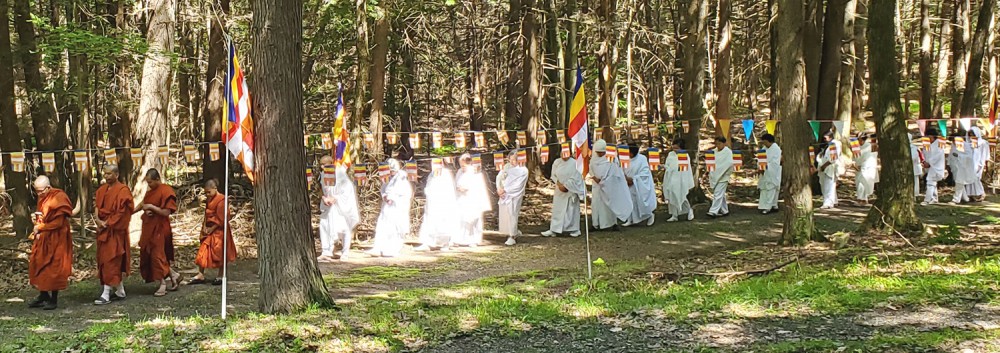
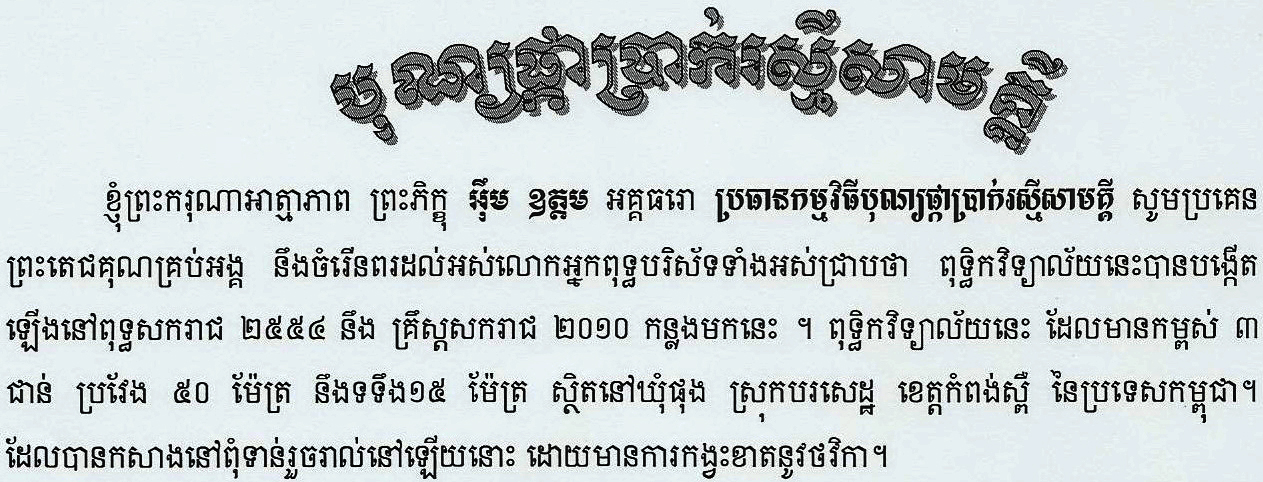
A Buddhist Fundraiser to Help Complete the Buddhist High School at Wat Bophavatei, Borseth district, Kampong Speu province, Cambodia on Sunday the 10th Waxing Moon of Citta B.E.2555, April 1, A.D.2012 Year of the Rabbit
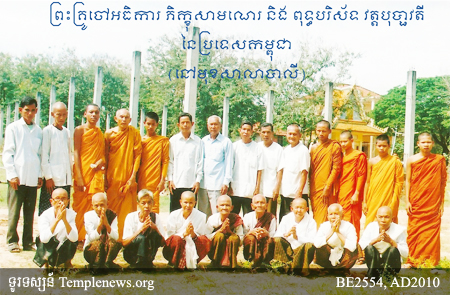
Complete ceremony:
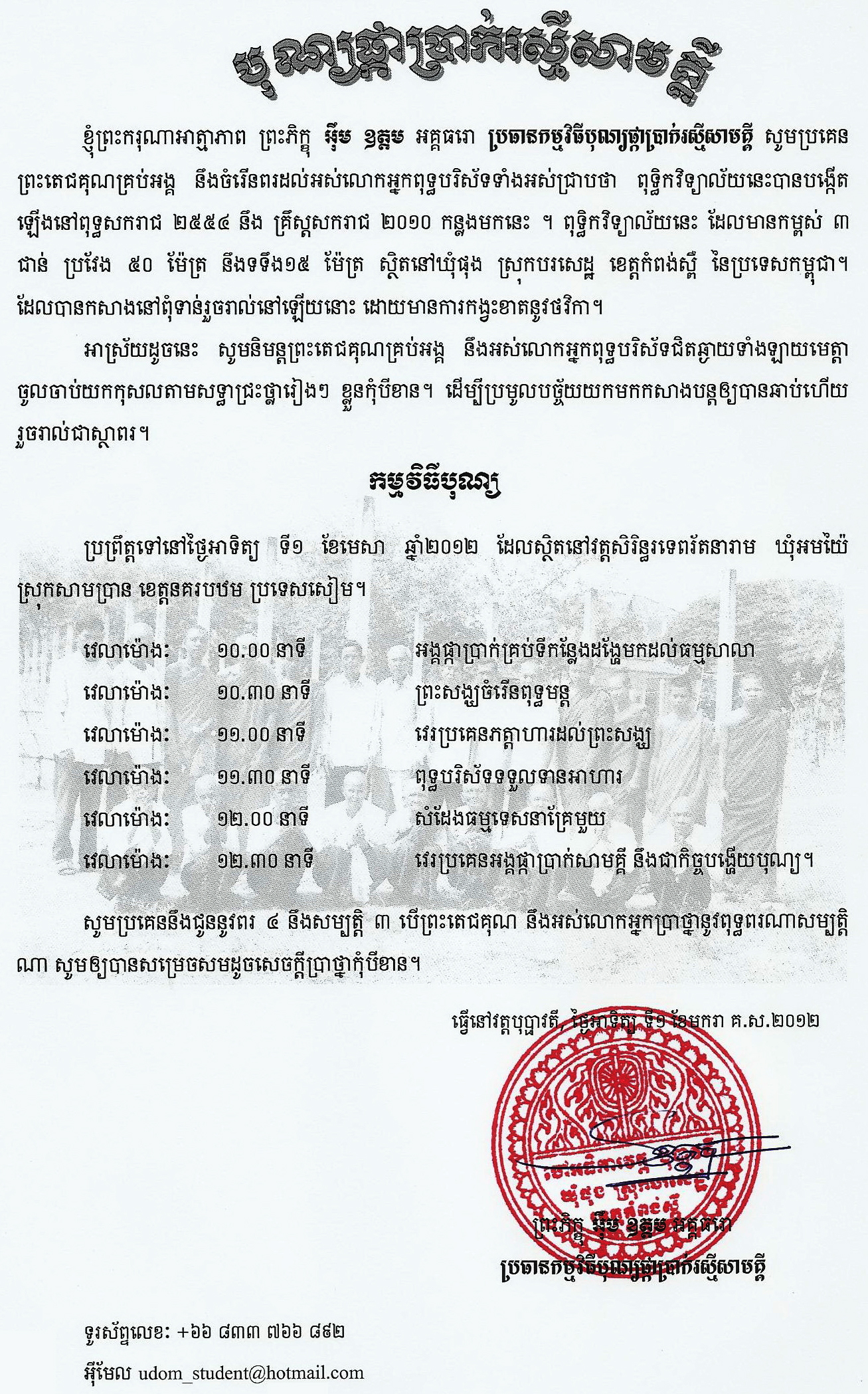
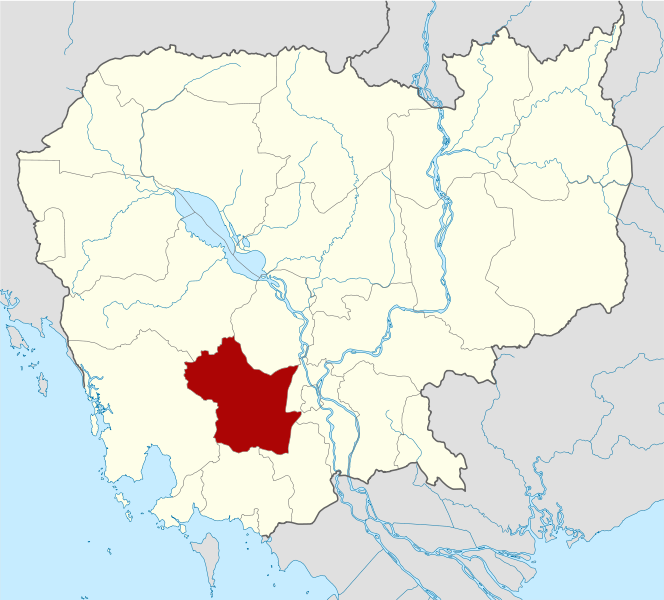
This future Buddhist High School has been established in B.E.2554, A.D.2010. When completed, it will be a three-storied building, length 50-meter (164-feet), width 15-meter (49-feet), located within the compound of Wat Bophavatei in Phong commune, Borseth district, Kampong Speu province, Kingdom of Cambodia.

Due to lack of funds, it is yet to be completed.

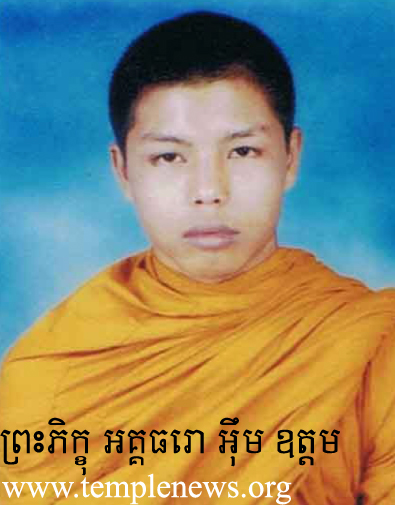
If you wish to make your contributions, please contact Ven. Aggadharo Im Udom, +66 833 766 892, Email:  udom_student@hotmail.com.

Other appeals: http://www.templenews.org/category/appeal-2

Comments (0)
Categories : Events

Wat Samraong Kandal

By templenews · Comments (0)
Thursday, January 5th, 2012


Wat Samraong Kandal
Located in Sen Sok district, Phnom Penh, Kingdom of Cambodia.

Phnom Penh (Khmer: ភ្នំពេញ, pronounced [pʰnum peːɲ] in Khmer and /pəˈnɒm ˈpɛn/ or /ˈnɒm ˈpɛn/ in English[2]) is the capital and largest city of Cambodia. Located on the banks of the Mekong River, Phnom Penh has been the national capital since the French colonized Cambodia, and has grown to become the nation’s center of economic and industrial activities, as well as the center of security, politics, economics, cultural heritage, and diplomacy of Cambodia.

Once known as the “Pearl of Asia”, it was considered one of the loveliest French-built cities in Indochina[3] in the 1920s. Phnom Penh, along with Siem Reap and Sihanoukville, are significant global and domestic tourist destinations for Cambodia. Founded in 1434, the city is noted for its beautiful and historical architecture and attractions. There are a number of surviving French colonial buildings scattered along the grand boulevards.

Situated on the banks of the Tonlé Sap, Mekong and Bassac rivers, the Phnom Penh metropolitan area is home to more than 2 million of Cambodia’s population of over 14 million.[4] The city is the wealthiest and most populous city in Cambodia and is home to the country’s political hub.

Comments (0)
Categories : Networks

Wat Kiri Bopta a.k.a. Wat Kampaeng

By templenews · Comments (0)
Thursday, January 5th, 2012


Wat Kiri Bopta also known as Wat Kampaeng
Established in B.E.2551, A.D.2008
Located in Prek Prasob commune, Prek Prasob district, Kratie province [Pronounce Krajes], Kingdom of Cambodia.

Kratié or Kracheh (Khmer: ក្រចេះ, literally “Powder Cosmetic”) is a province in northeastern Cambodia. It borders Stung Treng to the north, Mondulkiri to the east, Kampong Thom to the west, Kampong Cham and Vietnam to the south. The capital of the province is The Town of Kratié located in the Kratié District.

Comments (0)
Categories : Networks

Wat Bodh Veal

By templenews · Comments (0)
Monday, January 2nd, 2012

Wat Po Veal also known as Wat Bodh Veal
Located in Battambang provincial town, Battambang province, Kingdom of Cambodia.

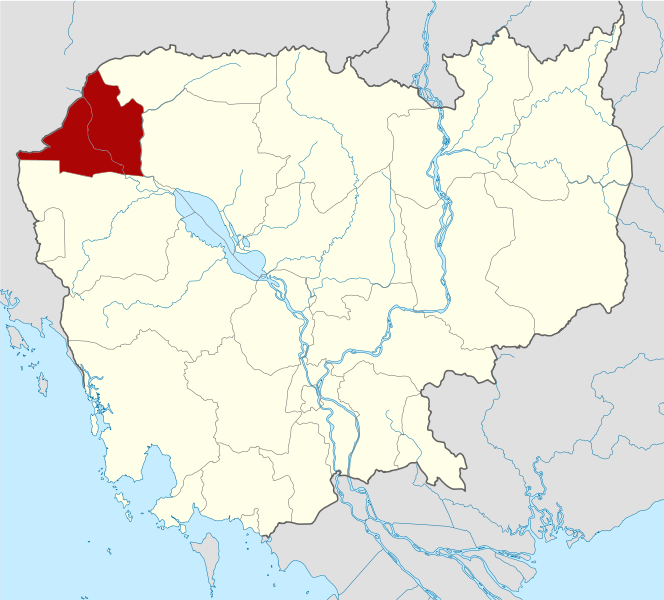
Battambang (Khmer: បាត់ដំបង) is a province in northwestern Cambodia. It is bordered to the North with Banteay Meanchey, to the West with Thailand, and to the East and South with Pursat. The capital of the province is the city of Battambang. The name, meaning ‘lost staff’, refers to the legend of Preah Bat Dambang Kranhoung. Battambang is one of the nine provinces that is part of the Tonle Sap Biosphere Reserve.

Comments (0)
Categories : Networks

Wat Svay Tamram

By templenews · Comments (0)
Monday, January 2nd, 2012


Wat Svay Tamram
Located in Baay Tamram village, Baay Tamram commune, Banan district, Battambang province, Kingdom of Cambodia.

Battambang (Khmer: បាត់ដំបង) is a province in northwestern Cambodia. It is bordered to the North with Banteay Meanchey, to the West with Thailand, and to the East and South with Pursat. The capital of the province is the city of Battambang. The name, meaning ‘lost staff’, refers to the legend of Preah Bat Dambang Kranhoung. Battambang is one of the nine provinces that is part of the Tonle Sap Biosphere Reserve.

Comments (0)
Categories : Networks

Wat Uddom Kiri Priksa

By templenews · Comments (0)
Monday, January 2nd, 2012


Wat Uddom Kiri Priksa
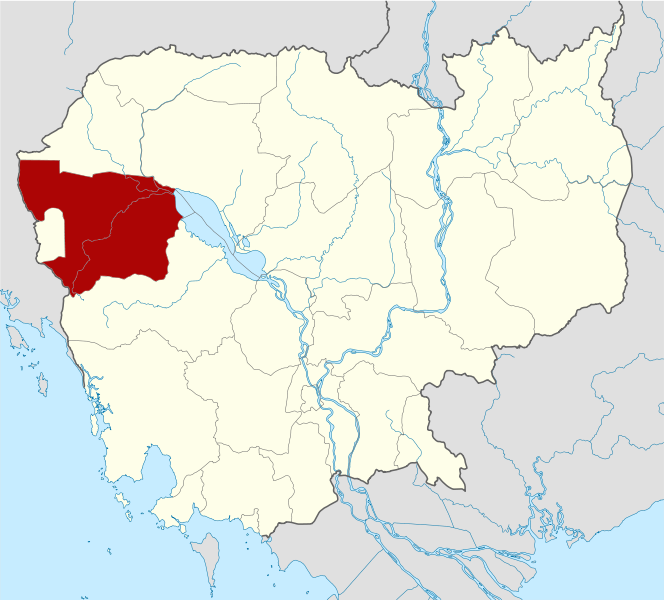
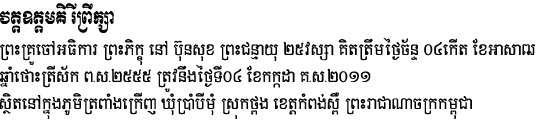
Abbot Ven. Nov Bunsok, age 25 as of Monday the 4th Waxing Moon of Assadh B.E.2555 equivalent to July 4, A.D.2011 Year of the Rabbit.
Located in Trapeang Kraenh village, Prambeimom commune, Thpaung district, Kampong Speu province, Kingdom of Cambodia.

Kampong Speu (Khmer: ខេត្តកំពង់ស្ពឺ) is a province of Cambodia. Its capital is Kampong Speu town.

Comments (0)
Categories : Networks

Wat Pranga Andaet

By templenews · Comments (0)
Monday, January 2nd, 2012


Wat Pranga Andaet
Located in Romjorng commune, Samraong district, Takeo province, Kingdom of Cambodia.

Takéo (Khmer: ខេត្តតាកែវ, meaning “grandparent’s crystal”) is a province located in southeastern Cambodia, on the southern coast of the Gulf of Thailand. Its capital is Takéo, a small city with a population of 39,186.

The province touches Kampot to the west, Kampong Speu and Kandal to the north, and Vietnam to the south. Takéo is often referred to as the “cradle of Khmer civilization.”

Comments (0)
Categories : Networks

Wat Botum Sombuor Meas a.k.a. Wat Sombuor Meas

By templenews · Comments (0)
Monday, January 2nd, 2012


Wat Botum Sombuor Meas also known as Wat Sombuor Meas
or Wat Padma Sombuor Meas
Located in Thmei village, Malai commune, Malai district, Banteay Meanchey province [Formerly Battambang province], Kingdom of Cambodia.

Banteay Meanchey is Victory Fortress.

Banteay Meanchey (Khmer: ខេត្តបន្ទាយមានជ័យ) is a Cambodian province. It is in the northwest of the country, and its capital is Serei Saophoan. In the Khmer language. There is an international border crossing to Thailand located within the province in Poipet town. Banteay Meanchey is one of the nine provinces that is part of the Tonle Sap Biosphere Reserve.

Comments (0)
Categories : Networks

Wat Sakor Borei Prek Liv

By templenews · Comments (0)
Saturday, December 31st, 2011


Wat Sakor Borei Prek Liv
Locaetd in Korng Meas district, Kampong Cham province, Kingdom of Cambodia.

Kampong Cham (Khmer: ខេត្តកំពង់ចាម) is a province in the east of Cambodia. The Mekong river bisects the province. Its capital is Kampong Cham city. With a population of over 1.6 million inhabitants, Kampong Cham is Cambodia’s most populous province.

Comments (0)
Categories : Networks

Wat Jom Kriel

By templenews · Comments (0)
Saturday, December 31st, 2011


Wat Jom Kriel
Located in Jom Kriel commune, Kampot district, Kampot province, Kingdom of Cambodia.

Kampot (Khmer: ខេត្តកំពត) is a southern province of Cambodia. Its capital is Kampot town. Kampot has a population of 627,884 and consist of eight districts divided into 92 communes with a total of 477 villages. Touk Meas City is located in Kampot Province.

Comments (0)
Categories : Networks

Wat Ang Khnaa

By templenews · Comments (0)
Wednesday, December 28th, 2011


Wat Ang Khnaa
Ven. Son Raksmei, age 31 as of Thursday the 5th Waxing Moon of Phussa B.E.2555, December 29, A.D.2011 Year of the Rabbit
Located in Tomnub Thom commune, Ponhea Leu district, Kandal province, Kingdom of Cambodia.

Comments (0)
Categories : Networks

H.H. Maha Ghosananda: “When You Make Peace with Yourself, You Make Peace with the World.”

By templenews · Comments (0)
Wednesday, December 28th, 2011

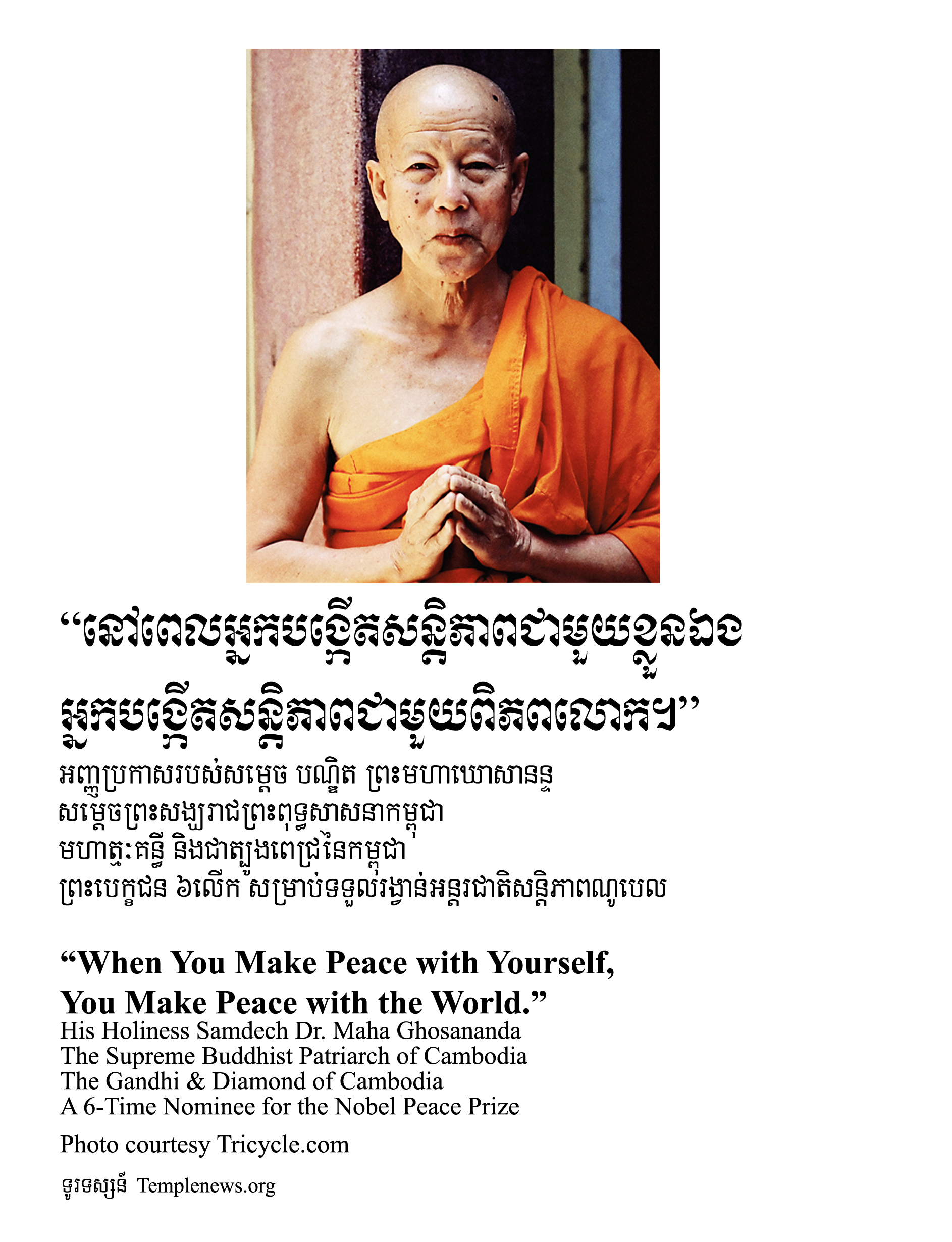
“When You Make Peace with Yourself, You Make Peace with the World,” His Holiness Samdech Dr. Maha Ghosananda, the Supreme Buddhist Patriarch of Cambodia, the Gandhi & Diamond of Cambodia, a 6-Time Nominee for the Nobel Peace Prize. Photo courtesy Tricycle.com


Comments (0)
Categories : Buddhism, Quotations

The Nine Special Qualities of the Buddha

By templenews · Comments (0)
Sunday, December 25th, 2011


The Nine Special Qualities of the Buddha
By U Jota Lankra

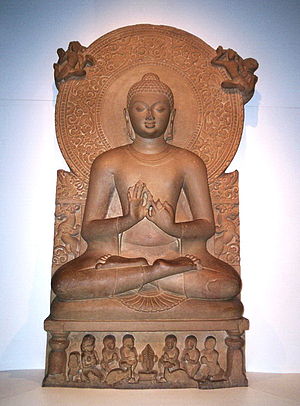
The Buddha Statue, 4th Century A.D., Sarnath Museum

That Blessed One is such since He is (1) Accomplished, (2) Perfectly Enlightened, (3) Endowed with knowledge and Conduct or Practice, (4) Well-gone or Well-spoken, (5) the Knower of worlds, (6) the Guide Unsurpassed of men to be tamed, (7) the Teacher of gods and men, (8) Enlightened, and (9) Blessed.
(1) The Accomplished One (Arahan)

According to Visuddhimagga-Atthakatha, Arahan (Accomplished) has five definitions. The Blessed One is accomplished for the following reasons: 1. because He is far away from all internal conflicts (Arahan), 2-3. because He destroyed the defilement — enemies and all the wheel’s spokes (Arahan), 4. because He is worthy of requisites (Arahan), and 5. because He is devoid of secret evil-doing (Arahan). (The beginningless round of rebirths is called the wheel of the round of rebirths.)

(2) The Perfectly Enlightened One (Sammasambuddho)

The Lord Buddha is the Perfectly Enlightened One because He has known all things rightly by Himself. In fact, He has of Himself known all the things, knowable things as knowable, comprehensible things as comprehensible, removable things as removable, realizable things as realizable,and things that may be developed as such.

(3) The Endowed One with Knowledge and Conduct ( Vijjacaranaasampanno)

The Lord Buddha is One who is endowed with three or eight kinds of knowledge and fifteen kinds of conduct.

“Vijja” means (higher) knowledge and “Carana”, good conduct (practice) that guides to a noble disciple and sends him towards the deathless.

There are “Three Kinds of Knowledge”
1. The knowledge that the Buddha recollects His past lives,
2. The knowledge capable of seeing the decease and rebirth of beings, and
3. The knowledge capable of eradicating defilements.

There are “Eight Kinds of Knowledge”
1. The knowledge or ability of attaining insight (With this knowledge, He knows, “my body is material, made from four great elements, born of mother and father, fed on rice and gruel, impermanent, liable to be injured and abraded, broken and destroyed, and this is my consciousness which is bound to it and dependent on it.”),
2. The knowledge of the production of a mind-made body, or the supernormal power of the mind-made body (With this knowledge, out of this body He produces another body, having a form, mind-made, complete in all its limbs and faculities.),
3. The various supernormal powers (With the super-normal powers, being one, He becomes many, and being many, He becomes one; He appears and disappears; He passes through fences, walls, and mountains unhindered as if through air; He sinks into the ground and emerges from it as if it were water; He walks on the water without breaking the surface as if on land; He flies cross-legged through the air like a bird with wings; He even touches and strokes with His hand the sun and moon, mighty and powerful as they are, and He travels in the body as far as the Brahma world.),
4. The divine ear (With the divine ear, He hears sounds both divine and human, whether far or near.),
5. The knowledge of others’ minds [understanding the ways of others’ thought] (With this knowledge, He knows and distinguishes with His mind the minds of other beings.),
6. The knowledge of previous existences [the remembrance of one’s former states of existence] (With this knowledge, He remembers many previous existences: one birth, two births,. . . . a hundred thusand births etc.),
7. The divine eye or the knowledge of the passing-away and arising of beings (With this divine eye, He sees beings passing-away and arising, inferior and superior, well-favored and ill-favored, to happy and unhappy destinations as kamma directs them.), and
8. The knowledge of eradicating defilements (With mind concentrated, purified and cleansed, unblemished, free from impurities, malleable, workable, established and having gained imperturability, He applies and directs his mind to the knowledge of eradicating defilements or destruction of corruptions. With this knowledge, He knows as it really is: “This is suffering, the origing of suffering, the cessation of suffering, and the path leading to the cessation of suffering.) (Dighanikaya, Vol.1,Samathaphala Sutta)

The Fifteen kinds of the Good Conducts are as follows:
1. Restraint by virtue (moral restraint),
2. Guarding the doors of the sense faculties (Watching over the sense-doors),
3. Moderation in eating,
4. Watchfulness,
5. Faith,
6. Shame of wrong-doing,
7. Fear of wrong-doing,
8. Great learning,
9. Energy,
10. Mindfulness,
11. Wisdom, and
12-15. Four Jhanas of the fine material sphere.

( 4) The Well-gone One or The Well-spoken One ( Sugata)

The term “Sugata” has two definitions:
1. One who has gone to the deathless, Nibbana and
2. One who speaks rightly, (It means that the Lord Buddha speaks only fitting speech in the fitting place).

The Six kinds of Speech
The Six Kinds of Speech are as follows:
1. The first one which is untrue, incorrect, and unbeneficial, and unwelcome and disagreeable to others,
2. The second which is true and correct, but unbeneficial, and unwelcome and disagreeable to others,
3. The third which is true, correct, and beneficial, but unwelcome and disagreeable to others,
4. The fourth which is untrue, incorrect, and unbeneficial, but welcome and agreeable to others,
5. The fifth which is true and correct but unbeneficial, and welcome and agreeable to others, and
6. The sixth which is true and correct, and beneficial, and welcome and agreeable to others.

Of them, only the third and sixth are the two kinds of speech that the Lord Buddha speaks because those are true, correct, and beneficial. (Majjhi-manikaya, Vol. 2, Abhayaraja-kumara Sutta)

(5) The Knower of the Worlds  ( Lokavidu)
The Buddha is the Knower of Worlds because He has known the world in all ways.
There are Three Kinds of World:
1.The world of formations (Sankaraloka),
2. The world of beings (Sattaloka),
3. The world of location (Okasaloka).

(6) The Incomparable Leader of men to be Tamed (Anuttaro purisadammasarathi)
The Buddha surpasses the whole world in the special qualities of virtue, concentration, understanding, deliverance, and knowledge and vision of deliverance, so He is the Incomparable Leader (Master) of men to be tamed.

(7) The Teacher of Celestial and Human Beings (Sattha devamanussanan)
It is usual for religious masters to seek advice or teaching from the deities or gods, but this would never happen in the case of the Buddha. The deities are also beings caught in the round of rebirths because they could not find the way out of it. The Buddha did not seek counsel from human beings either, and relied solely on His knowledge of the Dhamma. On the other hand, deities and human beings merely come to Him for counsel or advice and teaching, thus He is the teacher of them.

(8) The Enlightened One (Buddho)
The Lord has discovered the Four Noble Truths by Himself and awakened others to them, thus He is enlightened.

The Four Noble Truths that He has discovered are:
(1) the truth of suffering,
(2) the truth of the cause of suffering,
(3) the truth of the cessation of suffering, and
(4) the truth of the way leading to the cessation of suffering.

(9) The Blessed One (Bhagava)

The Buddha is endowed with the six things:
(1) Lordship [Issariya],
(2) Doctrine [Dhamma],
(3) Fame [Yasa],
(4) Glory [Siri],
(5) Wish [Kama], and
(6) Endeavor [Payatta], thus He is called the Blessed One.

1). He has the supreme lordship over His own mind as follows:
i. Anima – power to make the body minute (e.g. making the size of an atom),
ii. Laghima – power to make the body light (e.g. walking on air),
iii. Mahima – power to make the body huge,
iv. Patti – power to arrive where He wants to go,
v. Pakamma – power to produce what He wants by resolving, etc.,
vi. Isita – power to make anyone or anything follow His wishes,
vii. Vasita – power to create at will water, fire, etc., and
viii. Yatthakamavasayita – power to attain the perfection in all ways in Him who wants to go through the air or do anything else of the sort.
2). He has the supramundane Dhamma.
3). He has the greatly pure fame, spread through the three worlds, attained through the quality of veracity.
4). He has the glory of all limbs, perfect in every appearance, which is capable of comforting the eyes of people eager to see His material body.
5). He has the wish i.e., accomplishment of whatever is wanted by Him whether it be for His own benefit or for another’s (others’).
6). And He has the endeavor, the right effort, which is the reason why the whole world reveres Him.

The Benefits of Recollecting the Special Qualities of the Buddha

As long as someone recollects the Buddha’s special qualities, his mind is not invaded either by greed, hate or delusion. His mind is quite upright with the Buddha as object. And by absence of the invasion of greed, etc., his mind faces the subject of meditation with rectitude; then his applied and sustained thoughts occur with a tendency towards the special qualities of the Buddha. When he continually practices the applied and sustained thoughts upon the Buddha’s special qualities, happiness arises in him. And then with his mind happy, his bodily disturbance and mental disturbance are tranquillized by tranquillity which has happiness as proximate cause. When they have been tranquillized, bodily bliss and mental bliss arise in him. When he is blissful, his mind, with the Buddha’s special qualities as its object, becomes concentrated, thus the Jhana factors eventually arise in a single moment. But because of the profundity of the Buddha’s special qualities, or because of being occupied in recollecting special qualities of many kinds, the Jhana is only access and does not reach absorption (Appana). In addition, when a monk recollects the Buddha’s special qualities, he is respectful and deferential towards the Buddha. He attains an abundance of faith, of mindfulness, of understanding, and of merit. He has much happiness and gladness. He overcomes fear and dread. He is also able to bear pain. He comes to feel as if he were living in the Buddha’s presence. And his body, when the recollection of the Buddha’s special qualities dwells in it, becomes as worthy of veneration as a shrine room. His mind tends towards the stage of the Buddhas. When he encounters an opportunity for transgression, he has awareness of conscience and shame as vivid as though he were face to face with the Buddha. Besides, if he penetrates no higher, he will be at least destined to be born in a happy state. (THE PATH OF  PURIFICATION – VISUDDHIMAGGA, 229-230)

The Ten Wisdom-powers of the Buddha

The Ten Wisdom-powers of the Buddha are as followings:

1. Thanathanakosallanana= Understanding as it truly is the possible as possible and the impossible as impossible,
2. Kammavipaka nana = Understanding as it truly is the results of actions (kammas) undertaken, past, future, and present, with possibilities and with causes,
3. Sabbatthagamina patipada nana = Understanding as it truly is the ways leading to all destinations (all the states of existence and Nibbana),
4. Anekadhatu nanadhatu nanaa = Understanding as it truly is the world with its many and different elements,
5. Nanadhimuttikatanana = Understanding as it truly is how beings have different inclinations,
6.Indriyaparopariyattanana = Understanding as it truly is the disposition of the faculties of other beings, other persons,
7. Jhanadisankilitthavodanavutthananana = Understanding as it truly is the defilement, the cleansing and the emergence in regard to the Jhanas, liberations, concentrations, and attainments,
8.Pubbenivasanussatinanaa = Recollecting His mindfold past lives,
9.Cutupapatanana (Dibbacakkhunana )= (With the divine eye which is purified and surpasses the human, seeing beings passing away and reappearing, inferior and superior, fair and ugly, fortune and unfortune), Understanding how beings pass on according to their kammas, and
10. Esavakkhayanana = Realizing for Himself with direct knowledge, here and now entering upon and abiding in the deliverance of mind and deliverance by wisdom that are taintless with the destruction of the taints. (Majjhimanikaya, Mulapannasa, Mahasahanada Sutta)
Courtesy tbsa.org

Comments (0)
Categories : Buddhism

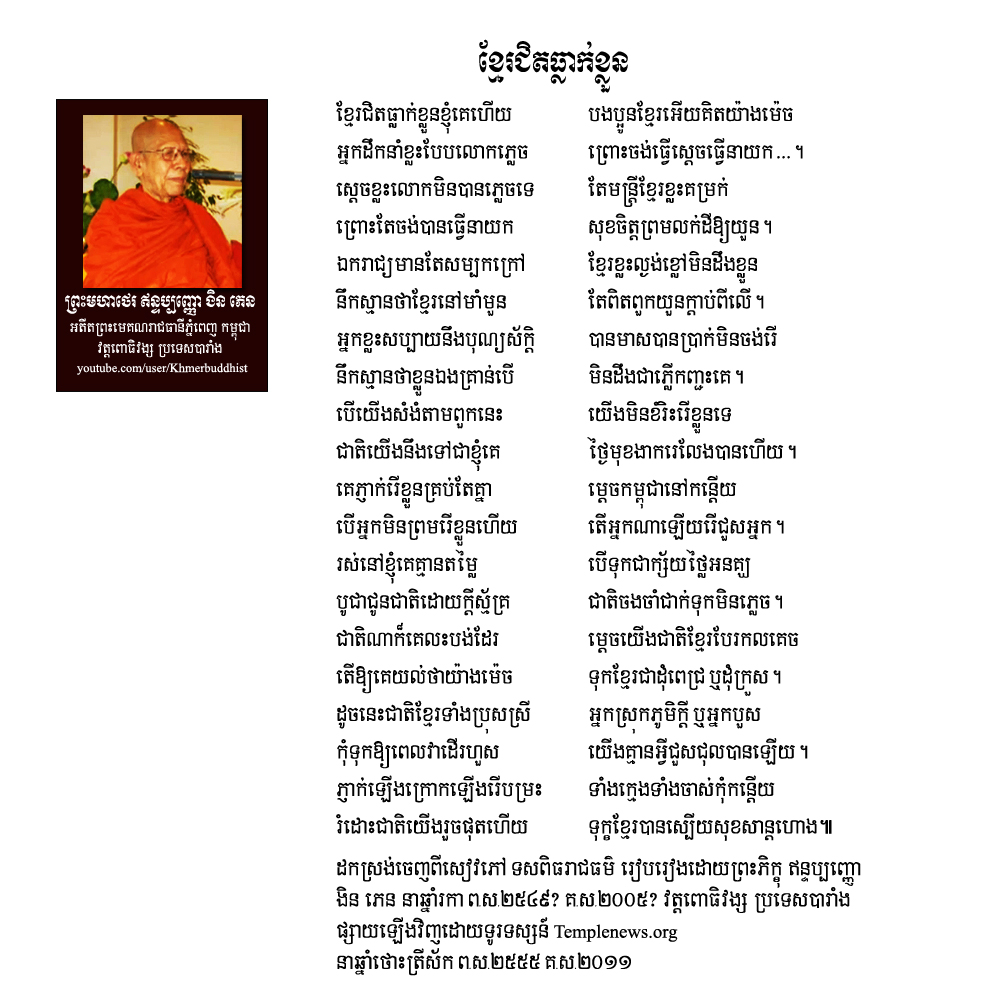
Poem: Khmer Nearly Lost

By templenews · Comments (0)
Monday, December 12th, 2011

The Maha Thera Indapanno Ngin Phen, Wat Bodhivangsa, Paris, France and former Bishop of Phnom Penh Buddhist Administration before the communist eras.

Poem in PDF poemMahaTheraIndapannoNginPhen

Comments (0)
Categories : Poems

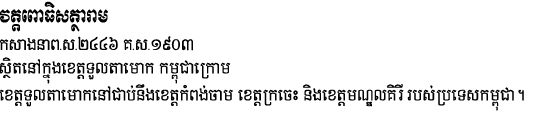
Wat Bodhi Saddharam

By templenews · Comments (0)
Sunday, December 11th, 2011


Wat Bodhi Saddharam
Established in B.E.2446, A.D.1903
Located in Tuol Ta Maok province, Kampuchea Krom.
Tuol Ta Maok province borders with Cambodia’s Kampong Cham province, Kratie province and Mondulkiri province.

Comments (0)
Categories : Networks

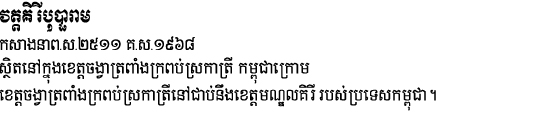
Wat Kiri Bopharam

By templenews · Comments (0)
Sunday, December 11th, 2011


Wat Kiri Bopharam
Established in B.E.2511, A.D.1968
Located in Changva Trapeang Krapoub Sraka Trei province, Kampuchea Krom.
Changva Trapeang Krapoub Sraka Trei province borders with Cambodia’s Mondulkiri province.

Comments (0)
Categories : Networks

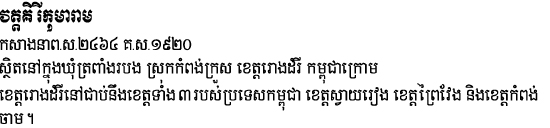
Wat Kiri Kumaram

By templenews · Comments (0)
Sunday, December 11th, 2011


Wat Kiri Kumaram
Established in B.E.2464, A.D.1920
Located in Trapeang Roborng commune, Kampong Kruos district, Raung Domrei province, Kampuchea Krom.
Raung Domrei province borders with Cambodia’s 3 provinces: Svay Rieng, Prey Veng and Kampong Cham.

Comments (0)
Categories : Networks

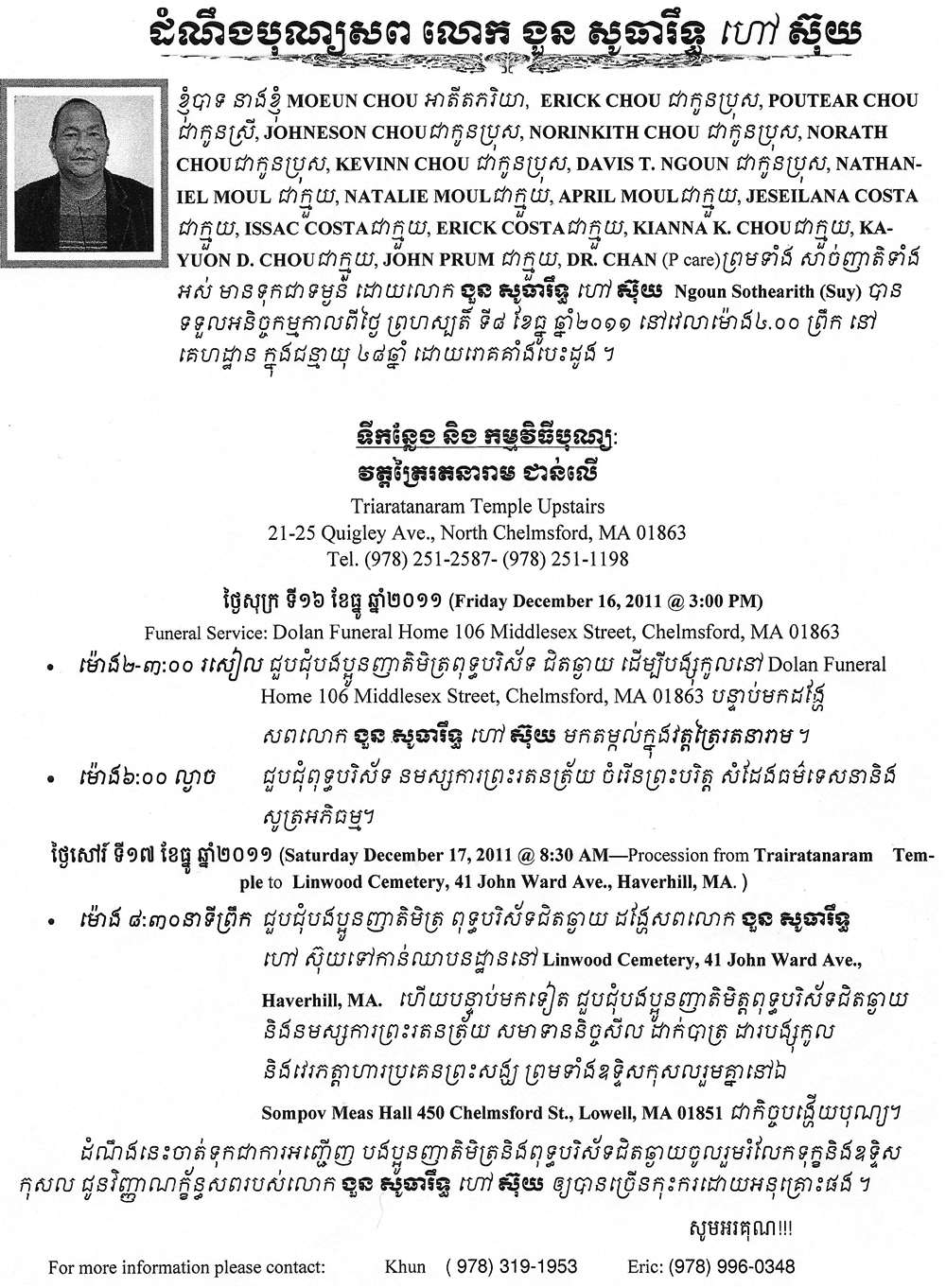
Obit: Ngoun Sothearith, age 48, passed away on Dec. 8, 2011 due to illness

By templenews · Comments (0)
Sunday, December 11th, 2011

The late Mr. Ngoun Sothearith of Cambodia, age 48, passed away in Massachusetts, United States of America, on Thursday the 13th Waxing Moon of Māgasira B.E.2555, December 8, A.D.2011 Year of the Rabbit, due to heart failure.

Comments (0)
Categories : Events

Wat Kirisenjaya

By templenews · Comments (0)
Friday, December 9th, 2011


Wat Kirisenjaya
Established in month of Māgasira B.E.2555, A.D.2011 Year of the Rabbit.
Located in the 317 th Disabled Veteran Rehabilitation Center, Koh Slaa, Kampot province, Kingdom of Cambodia.

Comments (0)
Categories : Networks

Wat Damnak

By templenews · Comments (0)
Thursday, December 8th, 2011


វត្ដដំណាក់
ស្ថិតនៅភូមិវត្ដដំណាក់ សង្កាត់សាលាកម្រើក ទីក្រុងសៀមរាប ខេត្ដសៀមរាប ប្រទេសកម្ពុជា
Wat Damnak
Located in Wat Damnak village, Salakomreuk commune, Siem Reap city, Siem Reap [Angkor] province, Kingdom of Cambodia.

Comments (0)
Categories : Networks
Next Page »

MEDITATION DOCUMENTARIES

DHAMMA TALK BY VEN. KETODHAMMO

ព្រះធម្មទេសនាសំដែងដោយ ព្រះធម្មវិបស្សនា កេតុធម្មោ សំ ប៊ុនធឿន

Dhamma talk by the late and renowned Cambodian Vipassana Buddhist Master Ven. Ketodhammo Som Bunthoeun.

TEMPLENEWS TV SHOWS

Watch our shows on LTC – Channel 95
Broadcast hours | Fridays: 4 – 5 pm, 8 – 9 pm
Tuesdays 11 am - 12 pm

Email: templenewscast@yahoo.com
Phone: 978.853.9623
Website: templenews.org
Youtube: www.youtube.com/templenewstv